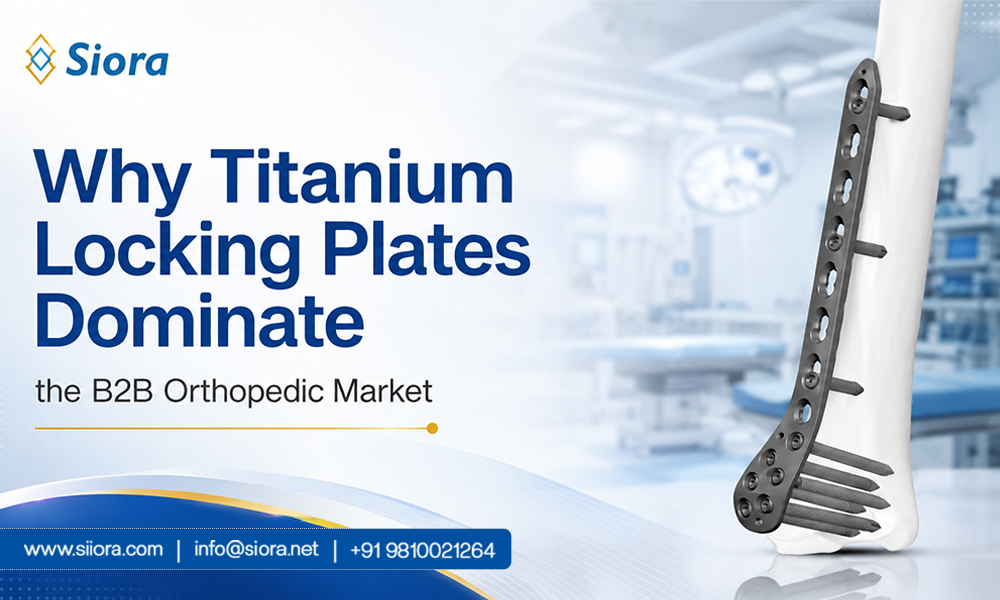
The orthopedic implant market has changed considerably over the past few decades. Hospitals, surgeons, distributors, and procurement teams are no longer looking only at implant availability. They want products that offer dependable clinical performance, manufacturing consistency, long-term value, and fewer concerns during implantation. This shift has helped titanium locking plates become an important part of the B2B orthopedic market.
From trauma centers to specialized orthopedic hospitals, titanium plating systems are increasingly preferred for cases where stability, biocompatibility, and implant strength matter.
Titanium Offers a Strong Balance of Strength and Weight
One of the biggest reasons behind the popularity of titanium locking plates is the material itself. Titanium alloys offer a useful combination of mechanical strength and relatively low weight.
For distributors and hospital buyers, this translates into robust implants without being unnecessarily heavy. For surgeons, the material provides a practical option for fracture fixation where stable support is required.
Titanium also has excellent corrosion resistance, which is an important consideration for implants intended to remain inside the body for extended periods.
Locking Technology Improves Fracture Fixation
The advantage is not limited to titanium. The locking mechanism of these plates has also contributed significantly to their market acceptance.
Unlike conventional plating, locking screws engage with the plate to create a fixed-angle construct. This can provide improved angular stability and maintain the intended relationship between the plate and screws.
This design is particularly useful in challenging fractures, osteoporotic bone, periarticular fractures, and situations where maintaining fracture alignment is important.
For B2B buyers, a well-designed locking system is better than other trauma implants. It can become an important component of a comprehensive trauma portfolio.
Biocompatibility Matters in Orthopedic Implants
Titanium is widely recognized for its favorable biocompatibility. Its established use in orthopedic and other medical implants has made it a familiar material for manufacturers, surgeons, and distributors.
This familiarity can also make titanium-based products easier to position in international markets, particularly when manufacturers maintain appropriate quality systems, material traceability, and regulatory documentation.
For orthopedic distributors, these factors matter because product acceptance depends not only on design but also on confidence in manufacturing quality.
Why Distributors Prefer Titanium Locking Plates
From a B2B perspective, product performance is only one part of the equation. Distributors also look for reliable supply, consistent dimensions, predictable quality, documentation, and portfolio depth.
Titanium locking plates can fit well into this model because they are available across numerous anatomical applications, including clavicle, distal radius, distal tibia, proximal humerus, femur, and other fracture indications.
A manufacturer capable of supplying compatible plates, screws, instruments, and related trauma products can further simplify procurement for distributors.
A Market Driven by Quality and Reliability
The growing demand for titanium locking plates reflects a broader change in orthopedic procurement. Buyers increasingly evaluate implants based on clinical utility, manufacturing quality, regulatory readiness, and commercial reliability.
For manufacturers, this means that simply producing a titanium plate is no longer enough. Consistent machining, accurate screw-hole geometry, surface finishing, inspection, packaging, traceability, and quality management all contribute to product confidence.
The Future of Titanium Locking Plate Systems
Titanium locking plates are likely to remain an important category within the global orthopedic implant market. Their combination of material properties and locking fixation technology makes them suitable for a wide range of trauma applications.
For B2B buyers, the real value lies in partnering with manufacturers that combine dependable implant design with consistent production, regulatory compliance, customization capabilities, and reliable international supply.
In a market where quality and trust influence purchasing decisions, titanium locking plates and even other orthopaedic implants have earned their position not simply because they are made from titanium, but because they offer a practical balance of performance, versatility, and long-term commercial value.
 siiora surgicals pvt. ltd