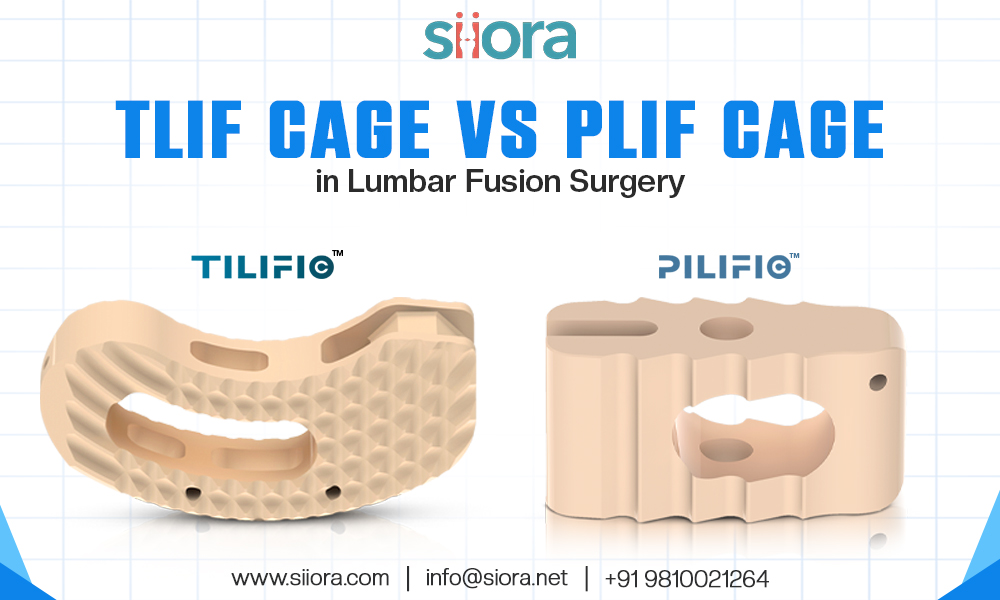
Lumbar fusion surgery is often performed to treat conditions like degenerative disc disease, spondylolisthesis, or spinal instability. In many of these cases, interbody cages are used to restore disc height and support fusion between vertebrae. Two commonly used techniques are TLIF (Transforaminal Lumbar Interbody Fusion) and PLIF (Posterior Lumbar Interbody Fusion). While both aim for the same outcome, the way they approach the spine and place the cage is slightly different. Understanding these differences can help in choosing the right technique for each patient.
What is a PLIF Cage?
PLIF is one of the older and more traditional approaches to lumbar fusion. In this technique, the surgeon reaches the disc space from the back, usually working on both sides of the spine. After removing the disc material, PLIF cages are placed into the intervertebral space, often in pairs.
Because the approach is more central, it typically requires some retraction of the spinal nerves. This allows direct access to the disc space but also increases the need for careful handling of neural structures. These cages are designed to provide strong anterior column support and are often used when bilateral access is preferred.
What is a TLIF Cage?
TLIF is a modification of the posterior approach that uses a more angled, one-sided entry into the disc space. Instead of working from both sides, the surgeon approaches from one side of the spine, usually through the foramen.
This means less manipulation of the spinal cord and nerve roots. A single cage is commonly used, placed diagonally across the disc space to provide stability. TLIF cages are shaped to fit this angled approach and still maintain good contact with the vertebral endplates.
Key Differences in Surgical Approach
The main difference between TLIF and PLIF lies in how the spine is accessed. PLIF involves a more central and bilateral approach, while TLIF uses a unilateral, slightly more lateral path.
Because of this, TLIF generally requires less nerve retraction. Many surgeons find this helpful in reducing the risk of nerve irritation during surgery. PLIF, on the other hand, offers a more direct view of the disc space, which can be useful in certain complex cases.
Stability and Fusion Outcomes
Both TLIF and PLIF cages are effective in achieving spinal fusion when used correctly. PLIF, with two cages, may provide slightly more immediate stability in some situations. However, TLIF has shown comparable fusion rates in most routine cases.
The success of either technique depends more on surgical execution, patient factors, and proper implant placement rather than the approach alone.
Recovery and Patient Impact
From a recovery point of view, TLIF is often considered less invasive. Since it involves less muscle dissection and nerve handling, patients may experience reduced postoperative pain and quicker mobilization.
PLIF can still deliver good results, but may involve a slightly longer recovery period in some cases due to greater tissue handling during surgery.
Conclusion
Both TLIF and PLIF cages play an important role in lumbar fusion surgery. PLIF offers a traditional and direct approach, while TLIF provides a less invasive alternative with reduced nerve manipulation. There is no best option out of these; the choice usually depends on the patient’s condition, the surgeon’s experience, and the specific goals of the procedure.
Looking for an advanced range of spine implants? Visit booth Y23 of Siora Surgicals Pvt. Ltd. at the premier WHX Miami 2026.
 siiora surgicals pvt. ltd