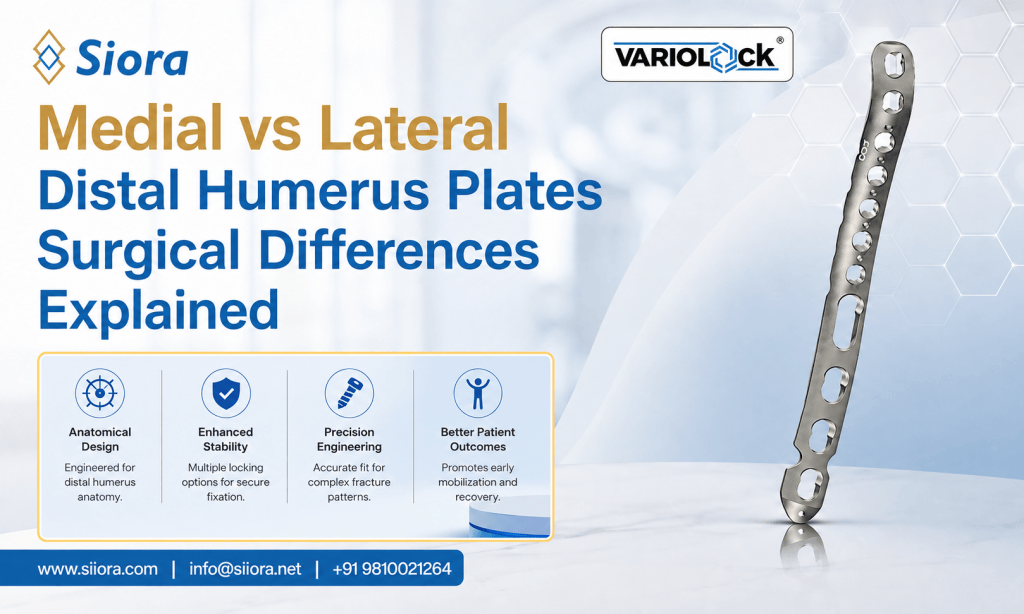
Distal humerus fractures are among the most difficult injuries to address because they involve the elbow joint. Here, stability and precise alignment are essential for restoring arm function. Depending on the fracture pattern, surgeons may choose a medial or lateral distal humerus plate or, in more complex cases, use both plates. While these implants may appear similar, their surgical applications, positioning, and indications differ.
Understanding these differences helps surgeons select the most appropriate fixation strategy for each patient and contributes to better clinical outcomes.
Understanding the Anatomy of the Distal Humerus
The distal humerus forms the lower end of the upper arm bone and connects with the radius and ulna to create the elbow joint. It consists of medial and lateral columns that provide structural support. When a fracture affects one or both of these columns, stable fixation becomes necessary to restore joint alignment and allow early rehabilitation.
Because the anatomy is complex and surrounded by important nerves and soft tissues, implant selection requires careful surgical planning.
What Is a Medial Distal Humerus Plate?
A medial distal humerus plate is designed to fit the inner side of the distal humerus. It is commonly used when the fracture extends into or primarily affects the medial column. The plate is contoured to match the natural anatomy and provides stable support through multiple locking and cortical screw options.
During surgery, the approach focuses on protecting nearby neurovascular structures, particularly the ulnar nerve, which lies close to the medial side of the elbow. Proper handling of these structures is essential to reduce the risk of postoperative nerve-related complications.
What Is a Lateral Distal Humerus Plate?
A lateral distal humerus plate is positioned on the outer side of the distal humerus. It is generally selected for fractures involving the lateral column or when additional support is required to restore stability. Its low-profile design helps accommodate the anatomy while minimizing irritation to surrounding soft tissues.
The lateral approach often provides excellent visualization of the fracture without requiring extensive soft tissue dissection. This can simplify exposure in appropriately selected cases and support accurate implant placement.
Key Surgical Differences
Fracture Pattern Determines Plate Selection
The most important factor influencing implant choice is the fracture configuration. Medial plates address injuries affecting the inner column, while lateral plates stabilize fractures involving the outer column. In highly comminuted or intra-articular fractures, surgeons frequently combine both plates to achieve balanced fixation.
Surgical Exposure
Medial plating requires careful exposure due to the close proximity of the ulnar nerve. Surgeons may need to identify and protect or occasionally transpose the nerve during the procedure. In contrast, lateral plating generally involves fewer concerns regarding major nerves, although soft tissue preservation remains equally important.
Stability and Load Distribution
Each plate provides targeted support to its respective column. When used together, medial and lateral plates distribute mechanical forces more effectively, creating a stronger construct that withstands elbow movement during recovery. This dual-column fixation is widely preferred for complex distal humerus fractures.
Implant Orientation
Depending on the fracture characteristics, surgeons may position the plates in parallel or perpendicular configurations. Both techniques have demonstrated reliable outcomes when applied correctly, and the final decision depends on fracture morphology, bone quality, and the surgeon’s experience.
Factors Influencing Surgical Decision-Making
Several considerations guide implant selection, including the patient’s age, bone density, fracture complexity, associated injuries, and expected functional demands. The objective is always to achieve stable fixation while preserving blood supply and minimizing soft tissue disruption.
Equally important is selecting anatomically contoured implants that fit accurately and allow precise screw placement. Well-designed fixation systems can simplify surgery and promote reliable fracture healing.
Conclusion
Medial and lateral distal humerus plates serve distinct yet complementary roles in fracture management. Although each plate is designed for a specific column of the distal humerus, many complex fractures require both implants to restore stability and elbow function. Careful assessment of the fracture pattern, meticulous surgical technique, and appropriate implant selection remain the foundation of successful treatment. With modern locking plate systems and thoughtful operative planning, surgeons can achieve stable fixation that supports early mobilization and improved patient outcomes.
If you are looking to become a trusted trauma implant distributor in Malaysia, contact Siora Surgicals Pvt. Ltd., a leading orthopaedic implants company in Malaysia.
 siiora surgicals pvt. ltd