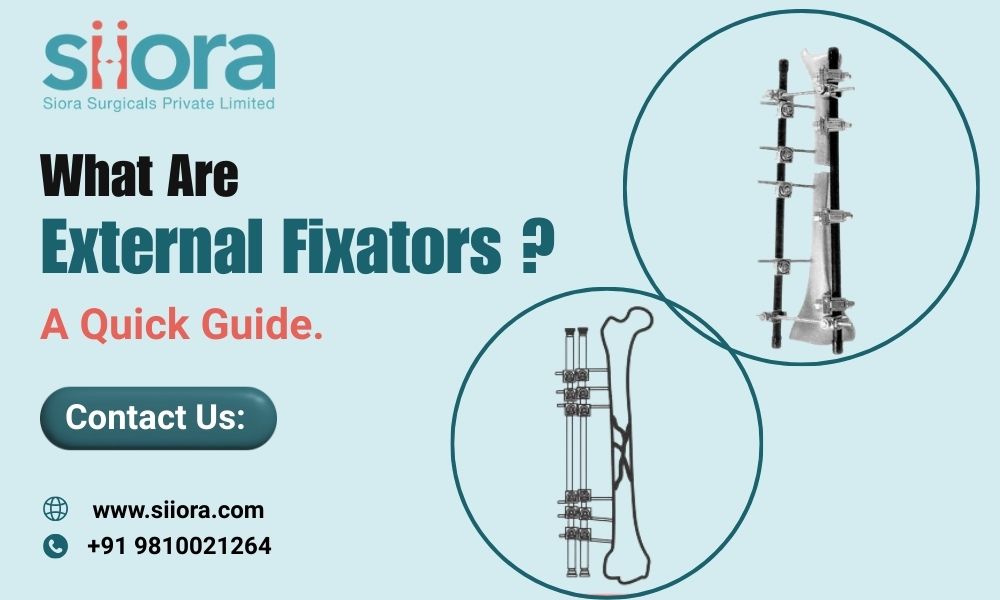
When someone breaks a bone, we usually think of casts or bone plates and screws to hold things together. But in more complex cases, like when the skin is badly damaged or the bone is shattered into pieces, doctors often reach for a different tool: the external fixator. It might look like something out of a sci-fi movie, but it’s a real-world medical device that can make a huge difference in recovery.
What Is an External Fixator? An Overview
An external fixator is a metal frame that sits outside the body and connects to the bone through pins or wires. These pins go through the skin and muscle and anchor into the bone, stabilizing it from the outside. That’s why it’s called “external”—the hardware isn’t buried under the skin like traditional internal fixation methods.
The setup might look intimidating, with rods and screws visible outside the body, but it serves a vital purpose: keeping broken bones aligned while they heal, especially when the injury is too severe for a cast or internal fixator alone.
When Are External Fixators Used?
External fixators are typically used in serious fractures, especially those involving:
- Open fractures, where the bone breaks through the skin.
- Comminuted fractures, where the bone is shattered into multiple fragments.
- Infected fractures, where the injury site needs regular cleaning and dressing.
- Limb lengthening or deformity correction, where bones are gradually repositioned over time.
They’re also valuable in emergency settings. For instance, if a patient arrives with multiple traumatic injuries, doctors can use an external fixator to quickly stabilize a fracture without performing a long surgery. This buys time and reduces the risk of complications.
How Do They Work?
The core idea is simple: provide a stable structure that holds the bone in place while nature does the healing. Surgeons use image guidance (like X-rays or CT scans) to precisely place the pins through the skin into the bone. These pins are then connected to rods or rings on the outside of the limb.
One common system is called the Ilizarov apparatus, a ring-shaped fixator often used for complex leg injuries. It allows gradual adjustments, which is helpful in slowly correcting deformities or lengthening bones.
Healing time varies. Some patients may need to wear an external fixator for a few weeks; others might wear it for months, depending on the severity of the injury and how well their body heals.
What Are the Pros and Cons of External Fixators?
Pros of External Fixators
- Quick stabilization: Especially useful in emergency or battlefield settings.
- Adjustable: Surgeons can tweak the frame to fine-tune alignment as healing progresses.
- Accessible wounds: Since the fixator is outside the body, doctors can easily monitor and treat wounds without interference.
Cons of External Fixators
- Visibility and discomfort: The device is external and can be bulky or awkward.
- Pin site infections: Where the pins go through the skin, there’s a risk of infection. Good hygiene and care are critical.
- Mobility challenges: While some fixators allow walking, others might limit movement, depending on the location and injury.
What’s It Like for the Patient?
It’s not the easiest journey. Living with an external fixator takes patience and discipline. There are daily cleanings, follow-up appointments, and often physical therapy to maintain strength and flexibility.
But many patients also say that, after the initial shock, they adapt. Some even decorate their frames or name them. It becomes a part of their healing story.
The Bottom Line
External fixators are an essential tool in orthopedic care, especially when bones are broken in complex ways that can’t be handled with a simple cast. They may look intense, but their purpose is straightforward: hold things steady, give the body time to heal, and allow doctors to monitor and adjust treatment along the way.
For patients and families dealing with a serious fracture, understanding what an external fixator is and why it’s being used can ease some of the fear. It’s not just a medical device; it’s a lifeline to recovery.
 siiora surgicals pvt. ltd